The cows of Montella (or, why rustic locations are great for Latin summer schools)
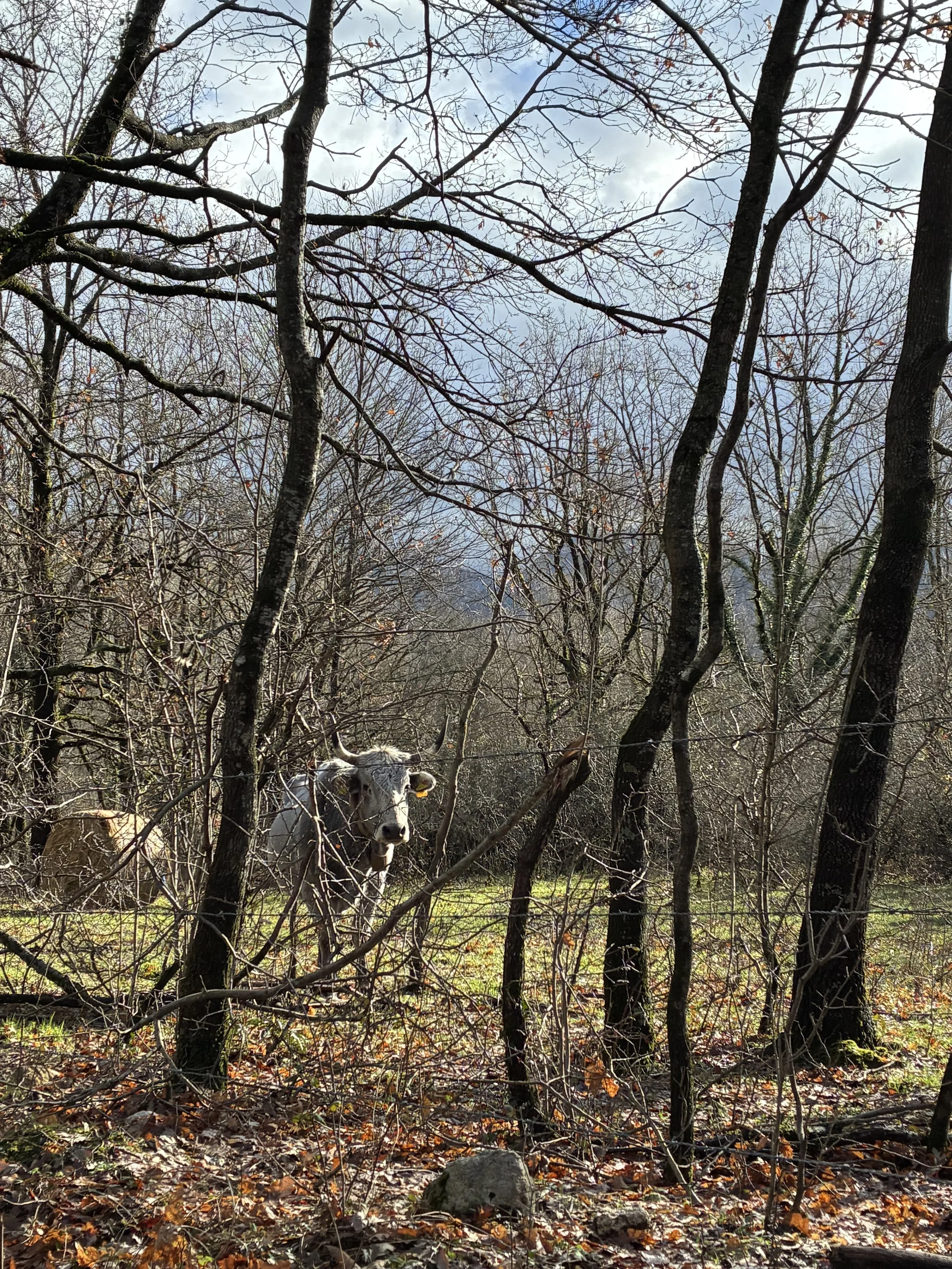
I have written before about Schola Latina’ssummer programs, but never, I think, about the location of the town where the courses are held. It is absolutely ideal. There is no better place for a Latin course in the world.
Montella is quite small, you see. There is only one bus to Rome each day and, as far as I can tell, only one bus at all on Sundays. If you tell people in nearby cities, for example, Salerno, where I lived briefly, that you go to Montella every summer to speak Latin at the feet of very learned teachers they will laugh at you. This is as obviously ridiculous as saying you learned Greek philosophy in someone’s basement in West Virginia. The biggest event of the year is the admittedly quite delightful chestnut harvest festival in the autumn. There is no university in Montella; there is not even a cinema. There are, however, cattle. They wander freely in the hills, along with cats, feral dogs, and other amusing creatures that you do not wish to meet on a mountain road alone at midnight. I greatly enjoy the sight of these cows.
Of course, in terms of personality, I don’t find cows as compelling as other animals, like donkeys. When I was very small, in America, I had a “friend” who was a donkey. I liked her much more than the chickens who were rather disagreeable and the goats who were prone to chewing on my sleeves. I’ve only ever seen one donkey in Montella, bursting out of the forest and running down a paved road at ten in the evening after our footsteps startled him. I would not keep a cow myself, because I am lazy, enjoy traveling, and wouldn’t know where to put her, but I enjoy watching them in Montella and hearing the funny bells while walking in the woods. The bells are nice because you know, generally, where the cows are and whether they are about to run you over.
Cows are probably so funny and fascinating to me because I have never had to feed, brush, or spend much time in the company of a cow. Being able to glance out a window to see them grazing among the chestnut trees is appealing, I suspect, largely because they are not my job. But the pleasure of being surrounded by nature cannot be denied. Also, in such a rustic location there is not much to distract from one’s reading. It is much harder to focus when there are operas to be watched, glamorous restaurants to be visited, and so on. In Montella, at Schola Latina’s summer school, one can simply read, study, enjoy the fresh air, and look at the delightful cows, of course.
If one wishes to go to a nightclub (I don’t, because I am a little mouse that lives in the library - a topo di biblioteca, which is the charming Italian way of saying “bookworm”; I think it is much more flattering to call someone a mouse), one finds that one cannot. There are no nightclubs. There are no bars, except in the Italian sense, and they tend to mostly sell rather good gelato. Nor is there a big museum, a theater, any famous restaurants. There are a few churches, some quite old and lovely, but those are not particularly interesting outside of mass, unless it is the season in which they display nativity scenes. They aren’t tourists, not in the summer, because it would not occur to any tourists to go there.
Without the distractions of a larger urban area, it is easier to settle down on a picnic blanket in the grass to read Vergil’s Georgics or climb a hill with a copy of his Eclogues in your hand. Vergil is, I think, the ideal poet for such a place. If you wander into the hills or cross into a nearby valley, you might feel you have fallen into one of his bucolic poems. There is nothing quite like the peace of reading in the hills in the afternoon after class, listening to the distant tinkling of the cow’s bells.